How to Choose Ski Boots - Size, Fit & Flex
Everyone’s foot is unique, and regardless of what some bootfitters will tell you there is no one “right” way to fit boots. The size, shape, flex, and features of your ideal boot will vary depending on ability level, aspirations, height and weight, frequency of days on the hill, and other factors. Because of their construction and the job they have to perform, ski boots will never be as comfortable as street shoes and you shouldn’t try to fit them the same way. Remember that the foam used for padding inside the boot will compress with use, so what seems like a very snug fit in a new boot will become more relaxed after just a few days of skiing. Here are some things you’ll want to consider when choosing ski boots.
Skier Type
Start by thinking about where you fit into this Skier Type chart. This will give you an idea of what type of fit, flex and features to look for in a ski boot. We’ve broken skier types into three groups based roughly on ability:
| Ability | Beginner – Intermediate | Intermediate - Advanced | Advanced - Expert | |||||||
| Style | Cautious | Average | Confident | Aggressive | ||||||
| Speed | Slow | Medium – Fast | Very Fast | |||||||
| Terrain | Bunny Slope / Groomers | Fast Groomers / All Mountain / Park and Pipe / Off-Piste | All Mountain / Park and Pipe / Off-Piste / Steeps / Cliffs / Race | |||||||
| Fit | Indicated Size or 1/2 size larger | Indicated size or 1/2 size smaller | 1/2 to 1 size smaller than indicated | |||||||
| Flex Index | Men's 60-80, Women's 50-70 | Men's 85-100, Women's 65-90 | Men's 105-130, Women's 85-110 | |||||||
Beginner/Intermediate

You prefer green and blue runs and typically like cruising on groomed terrain. You’re still working on mastering the mechanics of the sport, but are making regular progress. The best option for beginner/intermediates is a softer to medium flexing boot and a fit that will allow them to be comfortable all day long. (Note: An athletic skier who spends many days on snow can easily progress beyond this category in a season or less.)
Intermediate/Advanced

You enjoy a variety of speeds and conditions, including moguls and steeper terrain, and require more precise steering and control from your boots. You ski blue and some black diamond runs, cruise groomers with confidence and experiment with off-trail terrain. Intermediate/advanced skiers often have several years invested in the sport and should look for a medium flexing boot with a fit that’s precise enough to allow full control in a variety of conditions.
Advanced/Expert

You ski the entire mountain in all conditions with confidence. You easily make the transition from designated trails to off-piste in a variety of snow conditions including deep powder, crud, ice and moguls. You should be looking for a boot with a stiff to very stiff flex and a very precise fit. Expert level skiers sometimes intentionally downsize both in length and volume, then work with a bootfitter to make the boots comfortable. Note: Expert park and pipe skiers often prefer a roomier fit and softer flex in their boots compared to "traditional" experts.
How to Choose the Right Size Ski Boots
Ski boots are measured on a scale called Mondopoint, which is based on the length of your foot in centimeters. You can determine your Mondopoint size by placing your heel against a vertical surface like a wall with toes pointed outward, and measuring the distance from the wall to the end of your longest toe in centimeters (if you don’t have a metric ruler, you can multiply the length in inches by 2.54 to get the centimeter equivalent). If the length of your foot measures 26.5 cm (10.23”), your "indicated" Mondo size is 26.5.Using a conversion chart to translate your street shoe size to Mondopoint works but is less than ideal and should be a last resort, because shoe sizing is inconsistent and people often wear shoes that don't fit precisely. While most people can walk just fine in a shoe that's a size or two too big, skiing is a much more demanding activity.
Just because you measure a certain size doesn't mean you should necessarily buy that size ski boot, but it's a good starting formula for most skiers. Not every skier has the same performance requirements, tolerance for close-fitting footwear, or access to quality bootfitting. Here are our general recommendations:
Beginner/Intermediate Skiers should generally choose a boot close to their indicated Mondopoint length or slightly longer, even if it feels small. Keep in mind that the liner of the boot will compress after you ski in it a few times, and you’ll generate more space fairly quickly.
Intermediate/Advanced Skiers should also choose a boot close to their indicated size or slightly shorter, but in a stiffer flex. Pay attention to the width of the boot as well, and choose one that offers a snug fit if possible.
Advanced/Expert Skiers normally choose a shell size 1/2 to a full size smaller than their indicated size for a super precise and responsive fit, and a stiff or very stiff flex. Downsizing in ski boots may call for a collaboration with a skilled bootfitter to make the boots comfortable enough for skiing.
Note: Ski boot manufacturers don’t make boot shells in half sizes, so a 26.0 and 26.5 boot normally use the exact same shell - if you try on a 26.5 boot and it feels too big, the next size down will be a 25.5, not a 26.0. Sometimes manufacturers will make the liners for the full and half size differently, or use different insoles, but more commonly the two sizes are identical except for the sticker on the boot.
How Should Ski Boots Fit?
Ski boots should have a snug fit without cutting off circulation or causing painful pressure points. Slight to moderate pressure on your longest toes when the boot is buckled and your leg is in an upright position is usually an indication that the boot will be the right size after some use.If the boot feels too short, try flexing the boot hard with the upper buckles buckled – drive your knee forward into the tongue several times with force. This will push your heel back into the heel pocket of the boot and create more space in the front - you should feel little if any pressure on the toes while flexing the boot forward. Check the fit of the liner with it out of the boot shell to see if the source of the pressure is the toe of the liner rather than the hard plastic shell – if so, this can usually be stretched by your shop or bootfitter.
All ski boots will fit looser after a few days of skiing, and your object is to have a perfect fit at the end of the season rather than when the boot is brand new. Keep in mind that while it’s usually possible to enlarge a boot that’s a little too small, it’s virtually impossible to shrink a boot that's too big. When fitting (or skiing) ski boots, we suggest wearing a thin or very thin sock. While a thicker sock may be slightly warmer in some instances, the plastic shell and foam in the liner provide lots of insulation, and extra sock thickness between your foot and the boot shell diminishes control and response. In general, the best skiers wear the thinnest socks for this reason.

Ski Boot Shell Fit
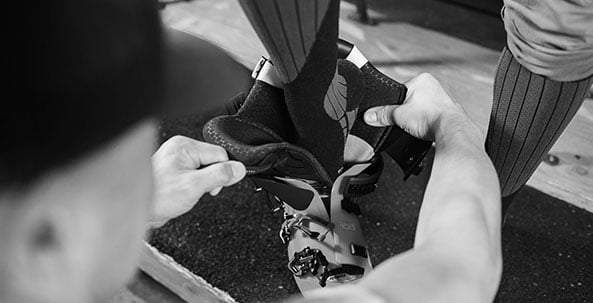
A common method of measuring the length of the boot interior is called a “shell fit,” and it’s a good way to see if a boot is close to the right size. This requires removing the liner (inner boot) from the shell. Insert your foot into the bare shell and slide your foot forward until your longest toes just touch the end of the shell. Then check the distance between your heel and the rear of the shell – most people do this with their hand or a piece of wood of a known thickness, like a ½” dowel. Bootfitters commonly refer to this measurement in terms of “fingers,” which is pretty imprecise because everyone’s fingers are a different size, but a finger tends to average around 15 millimeters (roughly 0.6”) for men. Using this standard, a “one finger” or “one-and-a-half finger” fit (15-22 mm or 0.6 to 0.9”) is considered a good performance fit. More than two fingers is usually too big, while less than one finger is getting into “race fit” range usually best left to elite skiers with access to a good bootfitter.Ski Boot Last or Width
The length of your boot isn’t your only fit option, there is also width or “last.” The last of a ski boot is based on the width of the forefoot measured on a slight diagonal across the metatarsal heads. Most manufacturers of alpine boots now make two or three distinct models or “lasts” to fit various types of feet. Generally, these lasts can be divided into narrow, medium and wide. Lasts with a wider forefoot normally have increased interior volume elsewhere in the boot as well.Narrow Last
Narrow lasted boots normally have a forefoot width of 97 mm to 98 mm, and are quite narrow through the midfoot as well. These boots are best for people with narrow and low volume feet.
Average Last
Average lasted boots have a forefoot width of around 100 mm (give or take a millimeter). These boots fit average feet well out of the box, and have a more relaxed fit through the midfoot and heel than narrow lasted boots.
Wide Last
Wide lasted boots are best suited to skiers with wider and higher volume feet, and typically have a forefoot width of between 102 mm and 106 mm.
If you know what width you normally take in a street shoe, you may be able to pick which of these forefoot models most closely matches your foot. An “A” or “B” width foot, for example, usually works best in a narrow lasted boot, while a “C” or “D” width normally fits an average last of around 100 mm. Skiers with an “E” or wider foot should look for a wider, 102 mm or wider last. As with boot lengths, the forefoot width is not an absolute standard among different boot manufacturers, and each has their own formula for determining other dimensions inside the shell, but this is a good general guideline.
Irregularities in the shape of your foot, such as bunions, bone spurs, abnormally long toes or bony protrusions that are not “average” in size or location can also cause fit problems. These problems are often best handled by having an experienced bootfitter modify the boot to accommodate the problem area rather than buying the next larger size.
Ski Boot Volume and Instep Height
Volume usually (but not always) goes hand in hand with forefoot width. Boots with a narrow forefoot generally have less volume through the midfoot and heel as well, and boots with a wide forefoot usually have a roomier fit elsewhere in the boot, too. Boot manufacturers don’t list volume as a number, unfortunately, so the best way to tell if a boot’s volume is right for your foot is to try it on.Instep height (the bony area on top of and slightly forward of your arch) is another key fit area, which bootmakers and models deal with in different ways. Your foot is quite sensitive to pressure on the instep, so wearing a pair of boots for 10 to 15 minutes will usually tell you if there’s an issue. A boot that’s too tight over your instep can be more challenging to fix than one that is too tight around the perimeter of the foot, so pay attention to this part of your foot when trying boots on.
Ski Boot Flex & Stiffness
Flex in ski boots refers to how difficult it is to flex the boot forward. Boot flex ranges from very soft to race stiffness, indicated by a numeric “flex index” that’s usually a number from 50 (soft) to 130 (very stiff). Often this number is written on the outside of the boot cuff. The method of determining flex index is not standardized between boot manufacturers, and one company’s 100 flex boot may not equal another company’s 100 flex boot, so use the numbers as a starting point but don’t get too hung up on them. Some companies use a 1-10 scale to for their flex rating, which is why we characterize flex as soft, medium, stiff, or very stiff in addition to giving a number rating.
Men’s Ski Boot Flex Ratings
Click your preferred 'feel' to shop
| Ability | Beginner – Intermediate | Intermediate - Advanced | Advanced - Expert | Expert - Race | |||||||
| Flex Rating - Men's | 60-80 | 85-100 | 110-120 | 130+ | |||||||
| Feel | Soft | Medium | Stiff | Very Stiff | |||||||
Beginner-Intermediate men’s ski boots range from about 65 to 80 flex index, with Intermediate-Advanced boots going from about 90 to 100. Advanced-Expert boots normally are in the 110 to 130 range. The stiffest race boots are rated at 140 to 150, which is far beyond what most skiers need or want and usually reserved for high-level competition skiers. Again, since there is no industry standard for measuring flex, it’s best to use flex index only as a general guide to choosing which model you’re interested in or as a way to compare models within a single brand.
Terrain, speed and type of snow play a role in choosing your flex as well. Pro level Freeride and Big Mountain skiers often choose a slightly softer boot than top World Cup racers, and pro park skiers go softer yet. Variable snow and very steep terrain often demand a bit more cuff movement, while a hard and uniformly smooth surface (like a race course) and techniques that demand tip pressure require a stiffer flexing boot. Personal preference and physical makeup are equally important. An athletic beginner may do just fine in a medium to stiff boot, and some expert skiers prefer a moderate flexing boot to a very stiff one.
Your height and weight are also contributing factors in choosing the best flex. Someone who is short and light doesn’t put as much leverage on a ski boot and a very stiff boot will limit natural body movement, while someone who is larger may require a stiffer boot, even if they are new to skiing. Keep this in mind if you are smaller or larger than average.
Women's Ski Boot Flex Rating
Click your preferred 'feel' to shop
| Ability | Beginner – Intermediate | Intermediate - Advanced | Advanced - Expert | Expert - Race | |||||||
| Flex Rating - Women's | 50-60 | 65-80 | 85-100 | 110+ | |||||||
| Feel | Soft | Medium | Stiff | Very Stiff | |||||||
Since women tend to have less body mass for their height and foot size than men, flex ratings are somewhat lower. For women's ski boots, Beginner-Intermediate boots hover around a 50 to 60 index, with Intermediate-Advanced boots ranging from about 65 to 80. Advanced-Expert boots range from 85 to 110. As with men’s boots, women racers and experts who prefer boots stiffer than a 110 flex will often have to special order them, and they will come with a very narrow and low volume fit.
Ski Boot Cuff Shape
Matching the cuff to the size and shape of your calf is an important part of your ski boot fit. The shape and height of both the shell and liner cuff can be a big consideration for women (whose calves are generally lower and proportionately larger than men) or those with very large calves. If the upper buckles on a boot are extremely tight out of the box, most boots have upper buckle ladders that can be moved to several different positions, sometimes with a screwdriver or allen wrench, to give you more adjustment range.
Most manufacturers are now offering women-specific boots that are designed to fit larger and lower calves, and many women’s models offer an adjustable cuff that will flare out to give you more fit options.
Ski Boot Forward Lean and Ramp Angle
Alpine ski boots normally have a fixed forward lean of between 11 degrees and 18 degrees from vertical. Most modern boot designs reflect the shift in ski technique toward a more upright style and have less forward lean than boots of a few years ago, but the forward lean that works best for each skier is highly personal, and most boots have some adjustment capability. Often this involves installing or removing a spoiler or shim in back of the calf. Alpine touring boots commonly come with two forward lean options.
Ramp angle, or the angle of the boot board (bottom interior of the boot) relative to the ski, is normally fixed as well, but can sometimes be adjusted by a bootfitter or by installing shims under the bindings or wedges between the bootboard and liner. Some skiers are more sensitive to ramp angle than others.
Features
Ski boots offer a number of features to enhance performance, comfort and ease of use. Many of these are aimed at customizing the fit and function of the boot, but they vary from model to model.
Liners
The liner is the removable, soft inner boot that protects and insulates the foot from the rigid outer shell. All liners will compress (“pack out”) and form to the skier’s foot with use, and a boot that feels tight the first time you try it on will often be just right after a few full days of skiing. Some boots offer a fully customizable thermo liner that can be heated in a convection oven or with heat stacks and formed to the owner’s foot, retaining the exact shape of the foot when they cool. This fitting process is usually best performed by a qualified ski shop; if you aren’t sure which type of liner you have, ask your shop or bootfitter.
A note on Intuition Liners: Standard in brands such as Full Tilt and many Dalbello and Scarpa models, Intuition is a brand of customizable thermo liners made from EVA foam, and can be added to other brands as an aftermarket option. The heat molding process is normally best performed by a qualified bootfitter or shop.
Heat Moldable Shells
Salomon (Custom Shell) and Atomic (Memory Fit) offer outer shells that can be heated in a convection oven and custom molded to your foot. This process works very well to change the shape of a boot shell that is just a bit too tight. The heat molding process should be performed by a qualified shop.
Power Strap
This is the velcro strap at the top of the cuff of your ski boot (some boots use a mechanical cinching buckle). When tightened, the power strap increases energy transmission and control. It acts as an additional buckle with a large range of adjustability and aids in reducing the gap between leg and boot. Power strap tightness is a matter of personal preference, so feel free to experiment.
Number of buckles
For years, four buckle boots were considered the only serious choice for adult skiers, and most performance overlap boots still have four buckles. Does that mean a four buckle design is better than a three buckle design, which in turn is better than a two buckle one? Not necessarily. If you have a great fit in any boot, and can stabilize your foot in the boot with fewer buckles, you’ll have a smoother profile, less weight, and easier access for bootfitters. A four buckle design MAY give you more options for local tightening and loosening, but the buckle closest to the toe is often mostly decorative. Three piece “Cabrio” designs typically use three buckles, while light touring boots often use two. Base your decision on fit rather than number of buckles.
Micro-Adjustable Buckles
These features are essential to achieving a precise fit. The micro-adjustment actually shortens or lengthens the buckle and will allow you to fine tune the tension between two settings. Turning the buckle clockwise shortens the buckle and tightens the fit; turning it counter clockwise lengthens the buckle and makes the fit looser.
Moveable Buckle Ladders
Most adult ski boots have moveable buckle ladders (the piece with the notches that the buckle wire attaches to). These normally can be moved using an allen wrench to allow the user a tighter or looser range of settings. You may need to drill a hole in the plastic buckle strap to move the ladder.
Cuff Alignment
Many boots offer the skier the ability to adjust the upper cuff angle to match the angle of the leg; this adjustability may be important if your natural alignment causes you to weight either your inside or outside ski edges disproportionately. Cuff alignment is normally done by adjusting the rivets attaching the boot cuff to the shell with an allen wrench.
Rear Spoiler
This is a removable wedge that sits between the liner and the shell directly behind the calf. It serves two functions: It increases forward lean by a few degrees and fills space in the upper cuff to reduce the gap between your leg and the shell, which can be important for those who prefer more forward lean or skiers with very thin legs. Spoilers may be attached to the cuff with screws or may simply attach to the back of the liner with velcro.
Though some fit adjustments are easy to do at home, customization of the following features may require the expertise of a trained boot fitter. Learn about the guaranteed comforts of our evoFit program, or visit our Custom Ski Boot Fitting: How to Make Your Boots Fit Better guide for more on how to customize your boots.
Ski Boot Footbeds
The footbed lives inside the liner, it’s the platform on which the skier’s foot rests. Most stock footbeds provide little support for the contours of the foot. We suggest an aftermarket footbed. Some footbeds are pre-molded and simply trimmed to the correct length while others are fully custom molded specifically to your feet. Footbeds can greatly reduce many fit problems.
Ski Boot Canting
Canting refers to adjusting alignment of the boot to correct a knocked-kneed or bowlegged stance through sole planing, cantable soles or wedges under the binding. Proper canting requires an accurate stance assessment and specialized tools, and not all shops or bootfitters are equipped to do it.
Some ski boot features are aimed at certain types of skiing, like alpine touring or park skiing.
Ski Boots With Walk Mode
Many ski boots come with the ability to switch from a fixed ski mode to a walk mode with greater range of motion. This feature is increasingly popular on “crossover” boots that are intended for use both in the ski area and for alpine touring.
Traction Soles
Grippy rubber soles aid in the ability to walk and hike on rocks, ice, and pavement. Many alpine touring boots have a rockered (curved) sole in front of the forefoot for a more natural walking movement. Freeride boots with a grippy sole offer traction for added security while booting and scrambling on rock. Not all traction soles will work with all bindings, so ask your shop if you are unsure about compatibility.
Interchangeable Soles
Some boots offer the user the option of swapping soles, usually from an alpine sole to an alpine touring sole or the reverse. Changing soles may limit your choice of binding, so ask your shop about compatibility if you have any doubts.
Adjustable Flex
Some boots allow you to adjust the forward flex of your boots with cuff hardware. Some also allow you to swap tongues of varying stiffness to fine tune the flex to your liking or to suit conditions.
Bootboards
Bootboards (also called "Zeppas") are the removable platforms that the liner sits on top of in the shell. Rigid bootboards provide the most efficient transfer of energy to your skis. Some bootboards are made out of rubber or have padding to soften harsh landings. These are typically seen in park and pipe boots and big mountain boots.
Shock Absorbers
There are other padded features often seen on park-specific boots. Look for padded spoilers, tongues, heels, and toes. All of these help in reducing shock commonly referred to as toe, shin, and calf-bang.
Purchasing Ski Boots on the Internet
Now that you know what you need from your boots and have the tools to begin your search, we strongly recommend you resist the urge to buy strictly on price or color. It’s wise to save elsewhere in your budget if it means getting the right boot.
No one knows how your feet feel better than you. If you think you’ve got a boot that comes close to the fit and flex you want, try wearing them at home for several hours before you head to the mountain with them. Put the boots on, buckle them as you would to ski, and stand up to watch a movie or a game. You’re going to have to be able to wear these things for at least that long if you’re going to ski in them, right? If they still feel pretty good after two hours or so, you may be ready to go. If you have localized pain at a toe or bony area, a bootfitter may be able to fix the problem. If you have serious fit issues with the boot, you’ll probably know it well before the two hours are up.
Your overall skiing experience depends on getting the fit and features that best suit your foot and skiing style, so take your time and feel free to call us for help at 1.866.386.1590.
Tired of Ski Boot Pain?
The evoFit program was designed to provide skiers with a high-quality custom boot fitting that balances comfort and performance for a wide variety of skier types. Learn more here, or visit any of our stores in Seattle, Portland, Denver, Salt Lake City, or Whistler for more details.Discover Seasonal Kids Ski Rentals
Having issues in getting your kids sized up for ski boots? Are they outgrowing them too quickly? Here at evo we know firsthand the struggle parents go through with finding their children new youth ski gear. This can often be an expensive and difficult task, that's why we've created our seasonal kid's ski rental program which offers kids full season use of a skis, bindings, poles, and adjustable boots that grow with them. Put the era of long gear rental lines every weekend behind you! Learn more:
Learn More With Our Other Ski Guides:
Skis - Kids' Size Chart and Buyer's Guide
Skis - Rocker Technology Explained
Ski Bindings – How to Choose & DIN Setting Chart
Ski Boots - Sizing & Buyer's Guide
Ski Boots - Boot Sole & Ski Binding Compatibility
Ski Boots – How to Make Your Boots Fit Better
Ski Poles - Size Chart
Skiing - Beginner Skiing Tips
Skiing - How to Fly With Skis
Skiing - How to Get in Shape
Ski Maintenance - Base Repair
Ski Maintenance – How to Store for the Summer
Ski Maintenance – How to Tune
Ski Maintenance – How to Wax
Gloves & Mittens - How to Choose
Goggles - How to Choose
Goggles - Wearing Goggles with Glasses
Helmets - How to Choose & Fit Guide
Outerwear - What to Wear Skiing & Snowboarding
Outerwear - How to Wash Waterproof Jackets & Clothing
Outerwear - Regional Ski & Snowboard Guide
Ski Socks - Sizing & Buyer's Guide
Avalanche Probes - How to Choose
Backcountry - Choosing an Avalanche Airbag Pack
Backcountry - Choosing an Avalanche Beacon
Backcountry - Climbing Skins Size Guide
Backcountry - Dynafit / Tech Binding Basics
Backcountry - How to Buy Alpine Touring Bindings
Backcountry - How to Buy Alpine Touring Ski Boots
Backcountry - How to Choose an Avalanche Shovel
Backcountry - How to Choose Climbing Skins
Backcountry Backpacks - How to Choose
Backcountry Basics - How to Get Started
Discover Our Favorite Gear:
The Best Women's Skis
The Best Beginner Skis
The Best All Mountain Skis
The Best Powder Skis
The Best Touring Skis
The Best Carving Skis
The Best Park Skis
The Best Intermediate Skis
The Best Freeride Skis
The Best Ski Bindings
The Best Touring Ski Bindings
The Best Men's Ski Boots
The Best Women's Ski Boots
The Best Touring Boots
The Best Ski Socks
The Best Beginner Ski Boots
The Best Value Skis
The Best Ski Poles
The Best Kids' Skis
The Best Kids' Ski Boots
The Best Cross Country Ski Boots
The Best Ski Boot Liners
The Best Gifts for Skiers
This is evo. We are a ski, snowboard, wake, skate, bike, surf, camp, and clothing online retailer with physical stores in Seattle, Portland, Denver, Salt Lake City, Whistler, Snoqualmie Pass, and Hood River. Our goal is to provide you with great information to make both your purchase and upkeep easy.
evo also likes to travel to remote places across the globe in search of world-class powder turns, epic waves, or legendary mountain biking locations through evoTrip Adventure Travel Trips. Or, if you prefer to travel on your own, check out our ski & snowboard resort travel guides and mountain bike trail guides.
Still have questions? Please call our customer care team at 1.866.386.1590 during Customer Care Hours. They can help you find the right setup to fit your needs.